 For leaders and investors
The AI Playbook for Mid-Market Leaders
Where AI can grow revenue and which workflows to change first
The playbook uses an illustrative insurance broker to show how online competitors can threaten revenue. A distributor’s late-order enquiry shows which tasks AI can take on and where a person should decide.
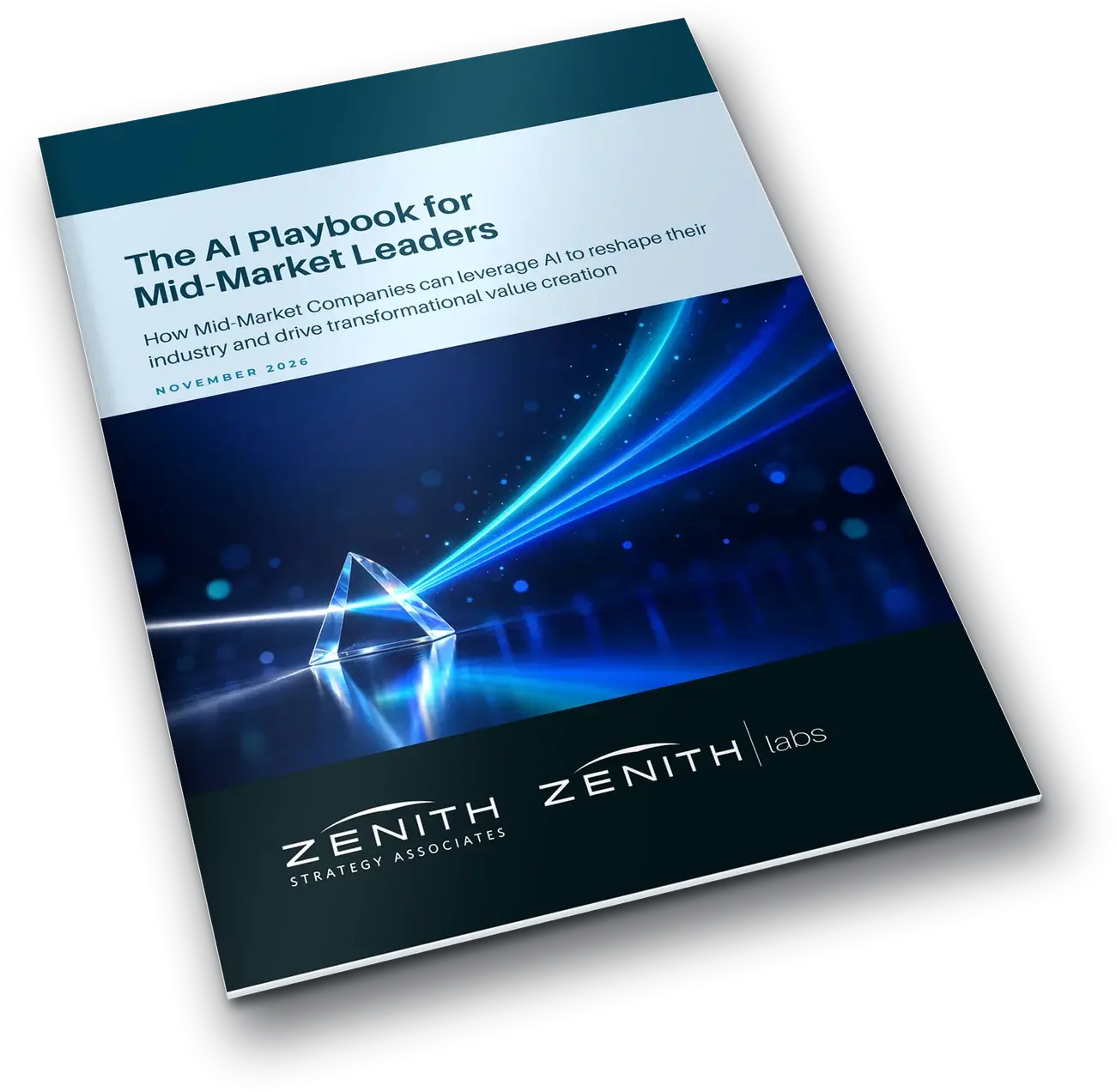
PDF by email. Includes the strategy scorecard and worked examples by function.
The Integrated AI Framework
Zenith’s Integrated AI Framework helps mid-market leadership teams decide where to invest in AI. The AI Strategy Assessment examines how AI could change industry profits and a company’s competitive position. The AI Value Creation Plan identifies which workflows to pilot and how to measure the return. Across both, the team agrees who is accountable, which decisions need human review and what to record.
AI Strategy Assessment
1 Industry Profit Pools
How AI will grow, shrink or shift the profit the industry earns, and redraw its boundaries, before any change shows up in the business’s own revenue.
- Enhanced Industry Propositions
- Industry Transaction Cost Reduction
- Industry Boundary Shifts
2 Sources of Competitive Advantage
The advantages rivals cannot buy with the same AI tools, whether proprietary data, a place in customers’ processes or an offer that joins AI to physical delivery.
- Data and Learning Flywheel
- Customer Integration
- Integrated Propositions
3 Enabling Architecture
How far the business’s systems and data would let AI agents work at scale. For most mid-market businesses the gap to being ready is small, and the largest part of it is commonly in the data.
- Cloud Platform Foundation
- Data Architecture
- Integration and Access
AI Value Creation Plan
4 AI Transition
A fresh look at each function’s remit in light of what AI can now do, then a review and redesign of its workflows, with pilots first and the benefits delivered in phases.
- Function Remit
- Workflow Review and Redesign
- Phased Benefit Delivery
5 Organisational Readiness
The capabilities that let the business go on finding new uses for AI after the transition program ends, as the tools improve and its structures and ways of working adapt to them.
- Opportunity Identification
- Resource Commitment
- Structural Adaptation
AI Risk and Governance
Governance starts with the first pilot and is strengthened as AI does more work. It rests on accountability and policies, external guardrails, human oversight and an audit trail, in line with the National AI Centre’s Guidance for AI Adoption.
The opportunity from AI, and how few businesses have captured it
Surveys in North America and France show that most mid-sized companies using AI have yet to embed it in their core processes, or to see time saved. That leaves the field open to early movers, who can reinvest the gains in growth before competitors respond.
- 20% to 50%
- of team hours can be freed up through automation and AI agents, our reviews of client teams have found.
- 16%
- higher sales where an AI assistant answered shoppers’ questions before they bought, across 44,614 online shoppers.
- 36%
- of North American mid-market companies using AI report having fully embedded it across their core processes.
- 17%
- of French mid-sized companies using generative AI report any time savings from it.
Sources: Zenith Strategy Associates, reviews of business functions in recent engagements. Fang, Yuan, Zhang, Donati and Sarvary, field experiments in online retail, 2025. RSM, Middle Market AI Survey 2026, U.S. and Canada, July 2026, 1,030 executives, self-reported. Bpifrance, annual barometer of French mid-sized companies, reported by Reuters, 27 June 2026, 534 company heads, self-reported.
Benefit relative to size
Relative to size, the benefit from AI is greatest in the mid-market
A mid-market business has a cost base large enough for savings to matter, the room to win share and enter adjacent markets, and the agility to change within months. A large enterprise has the scale, but legacy systems and layers of approval slow the gain.
Illustrative benefit over the next few years, relative to the size of the business.
- Revenue impact, from growth
- Cost benefit, from operational efficiency
Select a number on the chart, or a note below it, to see where each point sits.
Small businesses
Mid-market
Large enterprises
How AI is redrawing industry value chains, and where the profit is moving
Large US insurance brokers fell 9% to 12% on 9 February 2026, after comparison site Insurify launched a car insurance app in ChatGPT (Bloomberg, via Insurance Journal). Australian listed brokers fell sharply the next day (Insurance News).
- Enhanced Industry Propositions
- When AI lets some providers deliver faster, better or more consistent work, customers come to expect it of all of them. Fees that reflect hours of routine work are the most exposed, along with any provider that cannot keep pace.
- Industry Transaction Cost Reduction
- Brokers, agents and comparison sites are paid partly for information customers lack. AI assistants can now gather and compare much of that information at little cost, so intermediaries that mainly connect buyers and suppliers are the most exposed.
- Industry Boundary Shifts
- AI makes new services viable and nearby markets cheaper to enter, for incumbents and newcomers alike. A building products distributor, for example, can now use AI to prepare quantity estimates from small builders’ plans, once the work of a team of estimators.
What the businesses achieving returns from AI have in common
Few businesses can yet show a return on AI, and the usual reason is that they bought the tools and left the work unchanged.
Changing the work as well as the tools
The workflow is redesigned around AI, and the leadership team agrees beforehand what the released hours are for, whether more work from the same team, lower cost, quicker delivery or growth.
Buying before building
The first choice is the AI inside the business’s own software, then a specialist service. Only when neither fits, or ownership would set the business apart, is a bespoke AI agent built.
Giving the program one senior owner
All spending on AI is brought under one senior executive, who answers for the return it makes. In a mid-market company that is most often the chief executive, or another member of the leadership team.
Tracking benefits against the business case
A business case with agreed measures comes before any spending, and the benefits are then followed through to the profit and loss, where the board can compare them with the plan.
Managing adoption as change
Use of AI often lapses after the licences are bought unless each person has a defined task, the training for it and a manager who follows up.
The practices draw on surveys by McKinsey, KPMG and Menlo Ventures, on Humlum and Vestergaard’s study of around 25,000 Danish workers, and on our client work.
Workflow ratings
How far each workflow can be handed to AI, from Anchor to Automate
Assess a workflow by its volume, rules, ease of checking, stakes and need for judgement.
Rating factors
Rate a workflow
Choose a setting for each factor. Low scores 1 point, Medium 2 and High 3. For Low Stakes, choose High if an error would cost little. For Low Judgement, choose High if the work needs little specialist judgement.
Volume
How often the workflow runs, and how much team time it takes.
Clear Rules
Whether a capable new starter could learn the workflow from a short walkthrough.
Easy to Check
How quickly someone can check the output, compared with doing the work themselves.
Low Stakes
How small the cost of an uncaught error is, and how sensitive the data involved is.
Low Judgement
How little the workflow depends on one person’s expertise or relationships.
Assist 10 of 15 points
Use AI to prepare the work. A person checks the output and takes responsibility for the result.
Review the result with the people who do the work before changing how the workflow runs.
Delivering the benefits
Deciding whether an AI pilot should scale
Before a pilot starts, management records the current cost, turnaround time and error rate, or conversion and revenue where growth is the aim. It agrees what result would justify expanding the pilot and when to stop it. The PDF shows how to choose candidates for that test.
Starting point: the priorities set by the workflow review and the opportunity map
Stage 1
Redesign
Each priority workflow and the roles around it redesigned, and the delivery option chosen.
Typically a few weeks
Stage 2
Pilot
Two or three quick wins measured against a baseline, with a stopping rule agreed in advance.
Within one to two weeks
Stage 3
Scale
Proven workflows rolled out rapidly, one group at a time, with benefits tracked to the profit and loss.
As each pilot proves its value
Savings from each phase fund the next, and in time a growth program.
The scorecard and opportunity map in practice
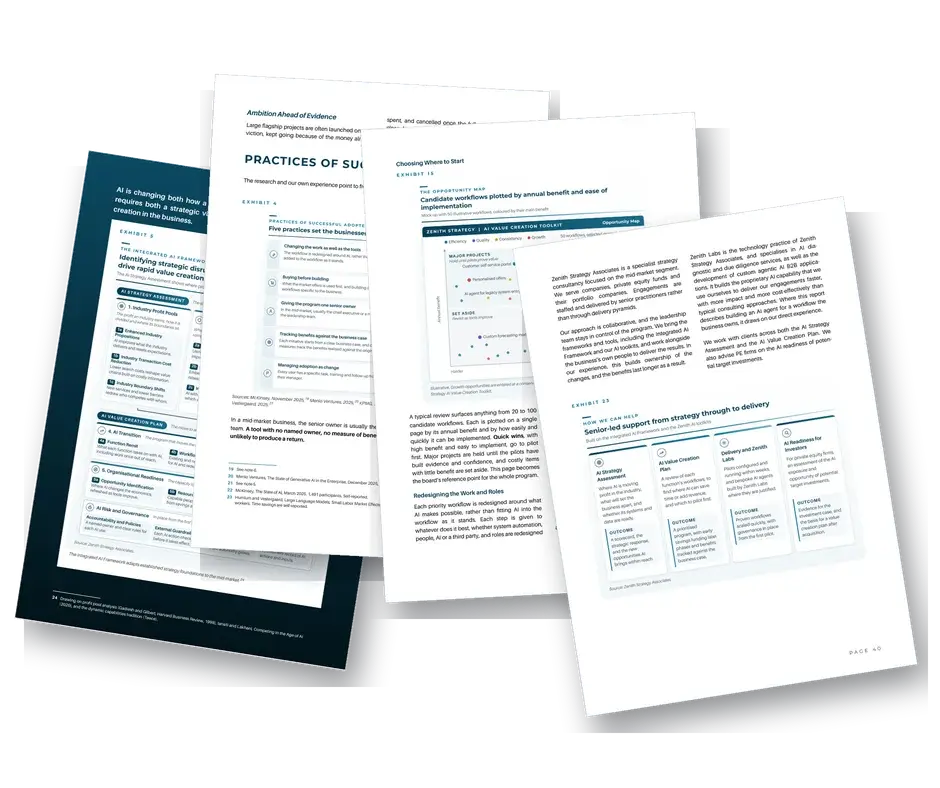
The PDF shows how a leadership team can assess where its business is exposed and decide which workflows warrant investment.
An illustrative insurance broker uses the strategy scorecard to assess what happens when small businesses can compare and buy policies directly. Pages 21 and 22 show how the ratings inform decisions about its sales channels and customer data.
For a distributor handling a late order, the question is which steps AI can handle and which decisions still need a person. Pages 25 and 26 show the redesigned workflow. On page 30, the opportunity map places candidate workflows by annual benefit and ease of implementation.
Pages 31 to 33 show worked estimates of the hours AI could free up by function. The governance section explains how managers can give AI more responsibility while retaining human oversight. The final example shows what a leadership team receives from the AI Diagnostic.
Inside the report
Framework exhibits and worked examples
Open a framework exhibit to see it full size. The scorecard, the opportunity map, the worked examples by function and the example diagnostic are in the report itself.
 In the full reportExhibit 9The AI Strategy Assessment scorecard, for an illustrative broking groupGet the report →
 In the full reportExhibit 15The opportunity map, with candidate workflows plotted by benefit and easeGet the report →
 In the full reportExhibit 16Where a customer service team’s time goes, and how much AI can take onGet the report →
 In the full reportExhibit 24The AI Diagnostic, as a mock-up for an illustrative broking groupGet the report →
Swipe sideways for more of the report’s exhibits.
AI is best approached as a growth program, paid for by the savings from running the business better.
Get the AI Playbook
Use the strategy scorecard to assess competitive exposure, then compare potential pilots on the opportunity map.