For senior executives and owners
Price is the fastest lever you have
The pricing strategies we recommend most often, drawn from twenty years of work with companies, private equity funds and their portfolio companies.
- Why a 1% price improvement is worth more than any other lever on the P&L
- The components of a price structure, most of which are rarely reviewed
- Where margin leaks away, and the audit that finds it
Sent as a PDF by email. Your details are not passed on.
As featured in
- Forbes
- Financial Review
- Expert360
- Clutch
- Eloquens
Why pricing first
The profit effect of a 1% improvement in each lever
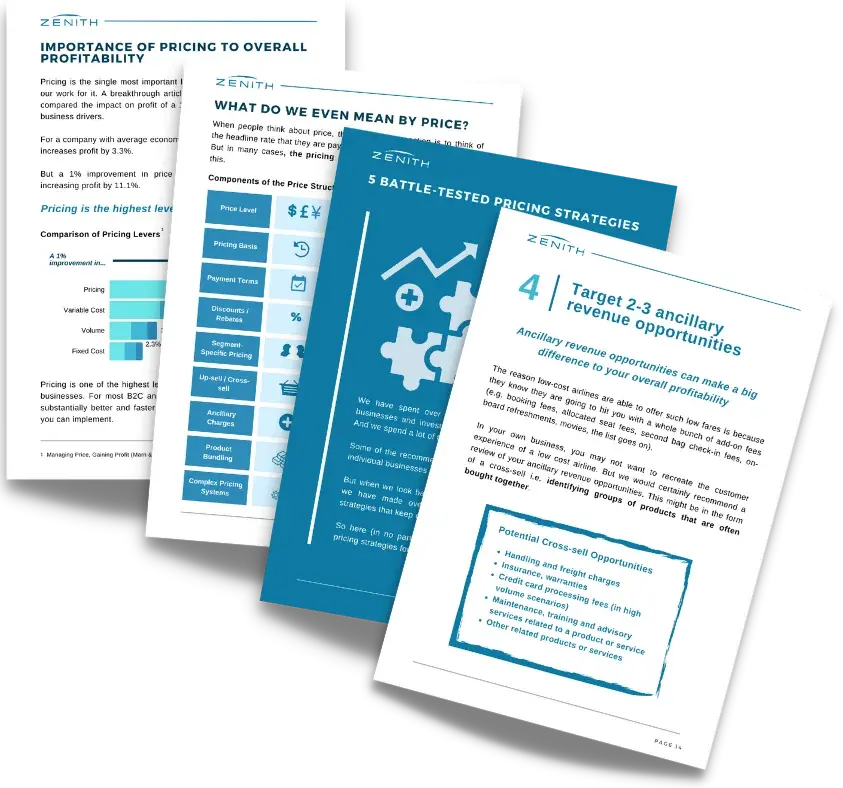
A price improvement passes almost entirely to profit. No other lever on the P&L moves profit as far for the same change, which is why the report starts with it.
Company with average economics. Source: Managing Price, Gaining Profit (Marn and Rosiello, Harvard Business Review).
The scale of it
The room for improvement in pricing
Poor pricing practice damages the economics of a business and can go unnoticed for years.
85%
of businesses believe they have significant room for improvement in pricing.
Source: Is Pricing Killing Your Profits (Bain & Company).
What we mean by price
The components of a price, and the one most reviews touch
Most discussions of price concern the headline rate, which is usually only one part of the structure and rarely the part with the most margin in it.
Price level
The headline rate of the product or service, and the only component most businesses actively manage.
Pricing basis
One-off against recurring fees, and the unit of measure that recurring fees are charged on, whether time or usage.
Payment terms
Timing and conditions. Up-front payment is a working capital decision as much as a pricing one.
Discounts and rebates
Reductions against the headline rate. Some of these buy incremental volume, and many do little other than dilute margin.
Segment-specific pricing
Different rates for groups of customers who value the product differently, and will pay accordingly.
Up-sell and cross-sell
Transaction value lifted through premium options or related products bought at the same time.
Ancillary charges
Freight, handling, warranties, support. Charging for them separately also lowers the headline rate that customers compare.
Product bundling
Related products or services packaged into a single offer, or unbundled and priced individually.
Complex pricing systems
Dynamic mechanisms such as yield management or auctions, where the market and the data support them.
A review that looks only at the headline rate leaves margin in the other components of the price.
The report
Strategies you can put to work this quarter.
Written as a working guide, with what to look at and what to be careful of under each strategy.
It opens with the economics, setting out what a price move is worth against the other levers available to you, and why so much of it is left alone.
Then the price structure itself, component by component, with the questions to ask of each one before you change a rate.
It closes on the strategies themselves, including a worked example of a mobile operator that found whole acquisition channels were losing money.
The strategies, in no particular order.
01
A review of headline rates
Customers are rarely as price sensitive as cost-plus thinking assumes.
02
An audit of margin dilution
Every discount, rebate and in-kind benefit granted over the last twelve months, with the value at stake and who approved each one.
03
Pricing for the unprofitable tail
Customer profitability by segment first, then by account where it matters.
04
Ancillary revenue lines
Cross-sell, unbundling, and services worth paying separately for.
05
Sales incentives tied to margin
Incentives adjusted for the margin realised on each deal rather than the revenue booked, with the activity behind it tracked.
From the report
Revenue lost before it reaches the invoice
Research by Bain & Company and Pricefx found the average industrial company loses more than 6% of revenue through off-invoice discounts and leakage.
Where it goes
Some of it is deliberate and useful. Much of it is granted once and never revisited, often with limited central control over who can offer what. A customer takes a discounted rate in return for volume, and nobody checks that the volume arrived. The five largest sources found were unrecovered freight, rebates, trade spending, consignment cost and early payment discounts.
What moving to value-based pricing is worth
Businesses that move from cost-plus to value-based pricing typically command premiums of 5% to 10%, with margin uplifts of up to a third. Customer satisfaction often improves at the same time, because the work involved is the work of understanding what customers value.
The Pricing Success Formula
Get the report
Enter your name and work email and we will send the report to your inbox.