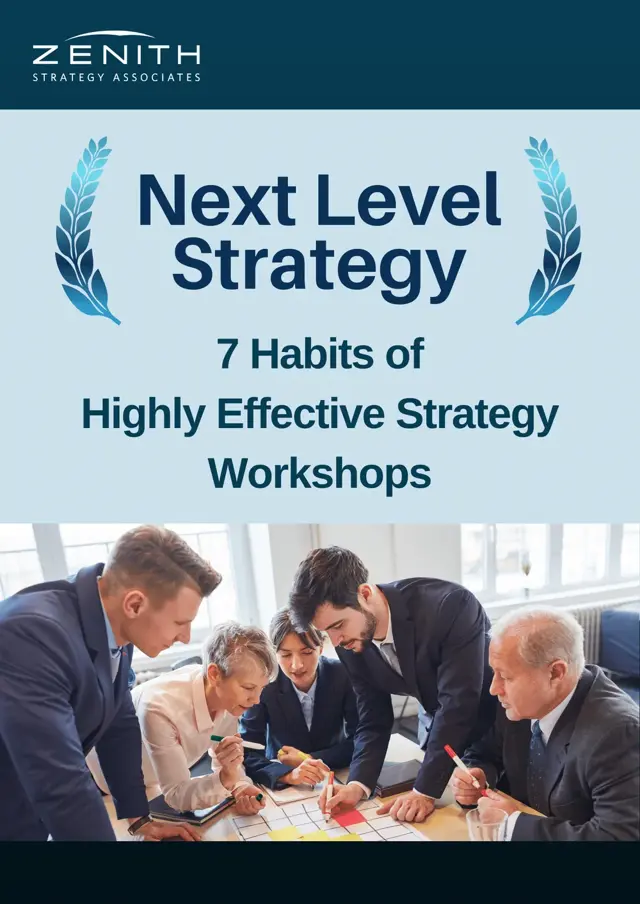
For chief executives and their teams
Most strategy workshops spend little time on strategy
The habits behind the ones that work, and the agenda we recommend, from twenty-five years of running them with management teams, boards and investors.
- The full agenda, item by item, with the format that suits each one
- What to keep off it, however popular the item
- The pre-workshop pack that makes the discussion worth having
Sent as a PDF by email. Your details are not passed on.
As featured in
- Forbes
- Financial Review
- Expert360
- Clutch
- Eloquens
What to leave out
What to keep off the agenda
Workshops build a momentum of their own. Items get added, the invitation list grows, and two days of material arrives with very little strategy in it.
Team building
Useful when a large group does not know each other. The attendance list for a strategy workshop should be focused enough that a few introductions will do.
Mission, vision, values
Without a strategy underneath them, these statements stay generic. The strategy comes first, and they can then be run as their own process where they are needed.
Divisional updates
Four or five divisions at an hour each is most of a day, and it pulls the room towards near-term trading. One focused update from the CFO early on does the same job.
The budget
Directional parameters belong on the agenda. Cross-divisional allocation does not, and it tends to consume the day if it is allowed in.
The checklist
The habits behind a workshop that works
01
Set the objectives and the agenda
The single biggest determinant of the day. Get this right and, in the report’s own words, you are 80% of the way there.
02
Think about the guest list
Decision-makers, the people who hold the market and financial data, and often the board or investors. Five people can work, and so can twenty-five, though the format changes with the number.
03
Do the preparation
Two months is ideal, two weeks is workable. Strategy should not be set on instinct alone, and the preparation pack is what prevents it.
04
Set the right environment
Room, screens everyone can read, and space to break into groups. Visit an unfamiliar venue first.
05
Facilitate, do not dominate
Stay neutral, keep time, summarise as you go, and mediate disagreement rather than closing it down.
06
Make it interactive
A workshop should not be a presentation on strategy. Open discussion, breakouts, and the occasional live vote keep the room contributing.
07
Have a plan for the week after
Capture the findings, set out the rest of the process, and be clear what each attendee is expected to do next.
Each habit is set out in full in the report, with the checklists behind it.
Habit one, in detail
The agenda we recommend
Two days for a complex group, half a day or a full day for a simpler business. The order matters more than the length, with context first, choices second and priorities last.
| Item | Content | Format |
|---|---|---|
| Introduction and objectives | What the day is for, the ground rules, and a short recap of the strategy concepts everyone will be using. | Sponsor opens, facilitator on concepts |
| External context | Market definition and size, growth outlook, the trends that matter, and where competitors have moved recently. | Presentation, then round table |
| Trading update | Recent performance and its drivers, consolidated and by division where the structure calls for it. | CFO, with discussion of the drivers |
| Current strategy | Where the existing initiatives stand, and what has been learned, including where the market assumptions turned out to be wrong. | Status recap, then group discussion |
| Corporate strategy | The corporate model, the balance between central functions and business unit autonomy, the portfolio, and what that implies for acquisitions or divestments. | Concept recap, then breakouts |
| Business unit strategy | Participation, positioning, customer strategy and operating model, taken one business unit at a time. | Breakouts, fed back to the room |
| Near-term profit improvement | Tactical opportunities alongside the strategic ones, so the roadmap includes something that delivers this year. | Framework, then group work |
| Prioritisation | Everything on the board, a preliminary assessment, and a first cut of the roadmap. | Facilitator-led, on the whiteboard |
| Close and next steps | The action list, who owns each item, and what happens to the output after everyone leaves the room. | Sponsor recap, facilitator on actions |
Habit six, in detail
Ways to keep the room contributing
Each has a failure mode, and the report sets out where each one works and where it does not.
Open discussion
Quick, informal, and easy to drop in at any point in the day. It becomes difficult past fifteen people, and can be dominated by a few voices. Group-think tends to set in once the chief executive has given a view.
Group breakouts
Four to six people, a topic each, a scribe, and a report back to the room. Time-consuming, and only as good as the person moderating. The facilitator should move between groups to keep them on track.
Live votes
Anonymous, on screen, and a useful pulse check before a discussion opens up. Yes, no or multiple choice only, so the findings are thin on their own. Someone has to set it up beforehand.
The report
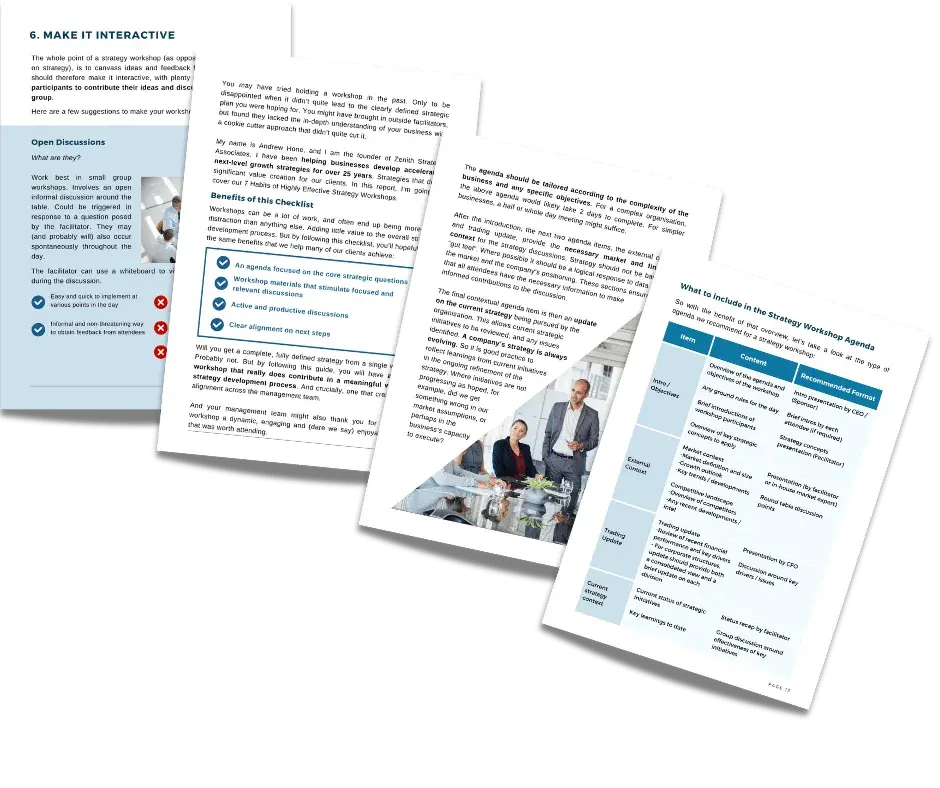
The report you can run a day from.
Written by Andrew Hone, who founded the firm and has been running these sessions for twenty-five years. It is written as a checklist.
It sets out the strategy framework the agenda is built on, covering participation and positioning, customer strategy and operating model, then corporate model and portfolio for groups that need it.
The pre-workshop checklist covers what to assemble in each area, from market and competitor material through to the organisation structure and internal survey findings.
It is clear about the limits. One workshop will not produce a finished strategy, but it should leave the team aligned and the process properly started.
Effective Strategy Workshops
Get the report
Enter your name and work email and we will send the report to your inbox.